How to Write a Thank You Song Someone Will Keep (Step by Step)

Caleb Turner · Head Songwriter & Creative Director
Updated September 17, 2026 · 24 min read
To write a thank you song — say, for the night-shift nurse who sat with your father, or the teacher who stayed after class with you all spring — name the single moment their help happened, decide which kind of gratitude you feel, write a plain four-line chorus that says it, add two short verses (the moment itself, and your life now because of it), then hum a simple tune and record it on your phone. Keep it under three minutes. No instrument, no training, no songwriting history required; an evening and one honest memory will carry the whole thing.
Gratitude is an odd thing to put into music, because the people most worth thanking are usually the ones least comfortable hearing it. A nurse will tell you she was only doing her job. A coach will shrug and say you did the running. A mentor retiring after thirty years has sat through enough speeches to recognize the shape of one coming. That reflex to deflect is the obstacle a thank-you song has to get past, and it is also the reason a song works where a card slides off: the details are too specific to wave away, and the melody keeps the words in the room a little longer than a handshake does.
When a thank-you draft lands on my desk, the weak ones nearly always read as a list of adjectives about the person — kind, patient, generous, selfless — with no trace of the single Tuesday afternoon when the help actually happened, and that missing afternoon is the entire song. So this guide is built around finding it. The six steps below work for a teacher at the end of the school year, a caregiver, a parent on a wedding day, a coach, a volunteer crew, or the friend who got you through the worst year you have had. If you would rather start by listening to how other people have said it, a list of existing gratitude songs grouped by who you owe is a good warm-up. And if you would prefer to hand your story to someone else and have it written and sung for you, that option is covered toward the end.
1Find the exact moment the help happened
Every thank-you song is secretly about one scene, so your first job is locating it. Set a timer for fifteen minutes and answer a single question in as many ways as you can: when, precisely, did this person help me? Not the general truth that they were always supportive, but the hour it became real. The morning your math teacher slid a folded note across the desk saying come see me at lunch. The night the nurse brought a second blanket without being asked and turned the monitor so its light stopped hitting your mother's face. The phone call from your friend that came three minutes after you had decided not to call anyone. Write each candidate as a short paragraph with a place, a time of day and at least one object in it. A good scene can be pointed at. If you cannot say where you were standing, you are still describing a quality rather than a moment.
Most people discover they have more than one scene, and that is useful rather than confusing. Line them up and ask which one the recipient would be most surprised you remember. That question matters because people who help others rarely track their own kindness. The coach remembers the championship; the kid remembers the drive home after being cut from the team, when the coach pulled over at a gas station and bought two sodas and said nothing for ten minutes. The surprise is the gift. When someone hears a small act they had long forgotten described back to them in detail, they learn that it landed, and learning it landed is what most helpers quietly want. The same principle drives writing a song for the friend who has seen you at your worst, where the unglamorous scenes outrank the photogenic ones every time.
If nothing comes, stop searching your memory and start interviewing the evidence. Scroll back through old texts from the period when the help happened and copy out anything they said word for word. Dig up the report card, the discharge papers, the program from the recital, the email that said you got the job. Ask someone who was there — a sibling, a classmate, a spouse — what they remember that person doing, because outsiders often saw the kindness more clearly than you did while you were busy needing it. Then add one line about cost: what did helping you take out of their day, their evening or their patience? A teacher who stayed late missed something to do it. A friend who drove four hours drove four hours back. Naming the cost, lightly, is what keeps a thank-you from sounding like a performance review.
Tip: Ban five words for the first draft: kind, amazing, patient, generous, always. If a line only works with one of them, the moment is missing from it.
2Decide which flavor of gratitude you actually feel
Gratitude sounds like one emotion, but in a song it splits into at least three, and the chorus gets sharper the moment you pick one. There is relief: you got me through, and I did not think I would make it. That is the nurse, the sponsor, the friend on the phone at two in the morning. There is debt: you gave me something I am still spending, and I know I can never square it. That is the parent, the grandparent, the mentor who took a chance on your résumé. And there is admiration: I watched how you did your job, and it changed how I do mine. That is the teacher, the coach, the boss retiring after decades. Write the flavor you feel as a single plain sentence at the top of your page. Read it aloud with their name in front. If it sounds like something you could say to their face, keep it.
Each flavor pulls the song in a different direction, which is why mixing them causes trouble. Relief songs want a before-and-after shape and a quiet ending; the listener needs to feel how close things came. Debt songs lean forward in time, toward what you are now doing with what they gave you, and they tend to land best when the chorus admits the debt cannot be repaid rather than pretending the song repays it. Admiration songs are the lightest to carry and the easiest to share in public, because they praise a craft rather than exposing a crisis — a good fit for a retirement lunch or a school assembly. Parents often receive debt songs on a wedding day, and our guide to writing for a father in June shows how that same gratitude plays when the man receiving it would rather talk about anything else.
Choose the flavor that fits the setting where the song will be heard, not only the feeling in your chest. A relief song about a hospital stay played at a crowded retirement party can pull a room into a grief it was not ready for, and a light admiration song sent privately to someone who carried you through a breakdown can feel like it missed the point. If two flavors are genuinely true, give one to the chorus and let the other appear once, in the bridge or the final verse. What you want to avoid is a chorus that thanks them for being there, for believing in you, for teaching you everything and for being a role model all at once. Each of those is fine. Stacked together they blur, and the person hearing it will smile politely at the stack without taking any single line home.
Tip: Try finishing this sentence out loud without stopping: “The thing you'll never know you did for me was…” Whatever comes out first usually tells you the flavor.
3Choose a small shape that fits the room
Skip inventing a structure. Verse, chorus, second verse, chorus, a two-line bridge, and a last chorus is the skeleton under most songs anyone has hummed, and it suits gratitude especially well because the chorus gets to repeat the thanks without it sounding needy. Assign each part a job before you write a word. Verse one holds the moment from step one, told slowly. Verse two jumps to now: the classroom you teach in, the shift you work, the kid you coach, the life that exists because they helped. The chorus holds the flavor sentence. The bridge, if you use one, is where the cost from step one gets named in a single honest line. Sketch that on an index card. Having the jobs written down stops the most common drift, which is a verse that starts retelling the moment and wanders into a list of their good qualities. If words like bridge, hook or pre-chorus are new to you, the core songwriting walkthrough this guide builds on defines each part and the rhyme patterns that sit most easily inside them.
Length depends on where it will play, so decide the room now. A song for one person, sent privately, can breathe a little: two verses of six lines, a bridge, around three minutes. A song for a retirement party or an end-of-year gathering should be shorter and quicker to its chorus, because rooms full of people drift after about forty seconds without a hook. If you are picturing a crowded banquet hall, listen to a handful of songs people play when a long career wraps up and notice how fast most of them reach the part everyone knows. A class performing for a teacher needs the simplest version of all: short lines, a chorus a nine-year-old can remember after two rehearsals, and verses that individual kids or small groups can take turns singing.
Group thank-you songs — a team for a coach, a ward for a volunteer, a church for a retiring pianist — need one extra structural decision: whose voice is the song in? Singular I makes it intimate but can leave everyone else standing around; plural we makes it inclusive but can go vague fast. The strongest group versions use we in the chorus and let the verses belong to specific people, each contributing one line with one concrete memory. That turns a generic group card into a small chorus of witnesses, and it gives the recipient several separate moments to recognize instead of one average one. Collect those memories early, by text or on a shared sheet, and set a deadline a week before you actually need them; group projects always arrive late, and the last three contributors are frequently the ones with the best lines.
Tip: Write the song's plan on one index card: moment, now, the feeling, the cost. If a line you love fits none of the four, save it for the card that goes with the song.
4Write the chorus first, in plain speech
Start with the chorus, because it is the part that has to survive being heard three or four times. Take your flavor sentence and say it the way you would if you ran into them at the grocery store and had thirty seconds. You stayed until the parking lot was empty is a chorus line. Your guiding light illuminated my path is a plaque. Gratitude pulls writers toward elevated language because the feeling is large, but the people worth thanking have usually been handed elevated language at every banquet and appreciation week they have attended. What they rarely hear is a small, checkable fact said back to them with conviction. Let the melody do the lifting. Your job in the chorus is to be specific enough that it could only be about this one person, and simple enough that you could sing it without reading it.
A four-line frame helps if you are staring at a blank page. Line one: the concrete moment, compressed to a single image. Line two: what they did next, or what it cost them. Line three: what that made possible, in your life now. Line four: the flavor sentence, with their name or the name you call them — Coach, Mrs. Alvarez, Nana, Doc — attached. Draft five versions of that frame quickly instead of polishing one. Read each aloud at normal talking volume. Cross out any line that would fit another teacher, another nurse, another friend, because that is the first-step problem sneaking back. Cross out any line you could not say while looking at them. The line that survives is almost always the plainest one, and it is seldom the one you were proudest of when you wrote it.
Test the chorus for repetition before you move on. Copy it four times down a page and read the stack from top to bottom. A good gratitude chorus gets heavier with each pass, because every verse you add gives the same words more to carry. A weak one gets lighter, then a little embarrassing, which is a sign it is leaning on decoration rather than fact. Also check the breath: sing each line once and notice whether you run out of air before the end. Long clauses feel meaningful on paper and fall apart in a real voice, especially a nervous one. And if you are writing for a group to sing, check the range. Hum the chorus at the lowest and highest points it reaches; if anyone in the group would have to strain, move the whole thing down and keep the words exactly where they are.
Tip: Put their name, or what you actually call them, at the start or end of a chorus line. A song addressed to one person stops sounding like a song about gratitude in general.
5Build two verses: the moment, then the life it made
Verse one is the scene from step one, and it should move slowly. Give it one place, one time of day and one object, and describe only what a camera could have caught. The hallway outside the principal's office. The vending machine on the fourth floor of the hospital at 3 a.m. The practice field with the sprinklers coming on while the coach made you run the drill one more time. Resist summarizing. A verse that covers a whole semester in six lines reads like a reference letter; a verse that covers ninety seconds reads like a memory. If the recipient needs context to recognize the scene, add one detail that pins it down — the weather, the song on the radio, the thing they were holding — rather than an explanation of why it mattered. The chorus will explain why it mattered. The verse only has to put them back in the room.
Verse two jumps forward, and the gap between the two scenes is where the emotion lives. Show what their help turned into: you now teaching chemistry in a room that looks a lot like theirs, you driving your own kid to practice, you holding the door for a new hire the way they once held it for you. Keep it concrete, because the natural temptation in verse two is to announce that you are grateful, and the chorus already does that. Just show the present and let the listener connect it to the past. This is also where grandparents and older relatives come alive in thank-you songs, because the distance between then and now is decades wide; songs written about grandmothers lean on that long view, and you can borrow its patience without borrowing a single word.
Keep each verse between four and six lines, and let the rhymes stay loose. A slant rhyme on a true detail beats a perfect rhyme that forced you to change what actually happened, and a thank-you song lives or dies on accuracy — the recipient was there, and they will notice. When both verses are drafted, read them to someone who knows the story without introducing them. If the listener laughs in recognition or goes quiet, you are close. If they say it's really sweet, the verses are still general, and the fix is almost always a smaller memory rather than a bigger feeling. Humor has a place here too: a teacher's catchphrase, a coach's terrible whistle, a nurse's running joke about the hospital coffee. One light moment in verse one lets the room relax before the chorus asks something of them, and it proves you were paying attention the whole time.
Tip: Give verse one an object they touched and verse two an object you touch now. When the two objects echo each other, the song does the connecting for you.
6Find a simple tune and record it
The melody is already buried in your chorus. Read it aloud five or six times as if you meant every word, and notice where your pitch naturally rises and where it settles. Exaggerate that shape until it tips from talking into singing. Keep the verses low and conversational, and let the chorus climb a few notes higher, because that lift is what tells a listener this is the important part. If you play guitar or piano, three or four chords are plenty. If you do not, a steady tap on the table is enough to keep time. Match the style to the person rather than to yourself: acoustic or folk for a quiet mentor, gospel for the church volunteer, country for the coach who tells stories, soul or R&B for the aunt whose kitchen radio never went off, pop for a teacher whose students will sing along.
Record it before you decide whether it is good enough. Sit in the quietest room you have, prop your phone up, and do three takes in a row without stopping to judge. The first take is usually stiff with nerves and the third has turned into a performance, so the middle one tends to sound most like you. A cracked note is not a flaw in this kind of gift; it is proof that you sat down and did something difficult on their behalf. Send the file to yourself the moment it exists and name it with their name and the date. If the song is for a group to perform, make a simple guide recording for rehearsals — just your voice and the tap — so everyone learns the same melody instead of five slightly different ones.
If you want the person to hear your moment with a real arrangement and a trained voice behind it, you can also have our songwriters build the finished recording from your story. You fill out a questionnaire that takes about five minutes — who they are, the scene you found in step one, the flavor of gratitude, the music they love — and real songwriters write an original song around it, sung by real vocalists in acoustic, pop, country, R&B, soul, gospel, folk or lullaby style. It arrives within 24 hours, or as quickly as an hour with express when the retirement lunch is tomorrow. Revisions are unlimited, the song lives on a private page you can share or download, and a 30-day 100% money-back guarantee covers the whole order. Some people do both: their own voice memo first, the studio version as the one that gets replayed.
Tip: Before you record, say the person's name once out loud and picture their face. It sounds sentimental, but it changes the take more than any vocal warm-up will.
A worked example: from “angel on the ward” to a chorus for a night-shift nurse
Here is the method running from start to finish, using an invented family so you can watch each decision. Marcus, forty-one, wants to thank Denise, the night-shift nurse who looked after his wife, Tanya, through eleven days in the cardiac unit last winter. Tanya came home. Marcus has written Denise a card twice and thrown it away twice, because nothing on the page felt equal to what happened. His first attempt at a chorus went where nearly every first thank-you draft goes:
“You were an angel on the ward, / so kind and caring every night, / you always had a gentle word, / thank you for being our light.” Every word in that is sincere, and not one of them belongs to Denise. Put any nurse's name on it and nothing breaks, which is exactly the diagnosis from the top of this guide: a list of qualities where a moment should be. So Marcus went back to step one and set the timer.
The scene surfaced on the third page. On the fourth night, around 3 a.m., Tanya's heart rate spiked and she started to panic. Denise came in, pulled the visitor chair right up against the bed, took Tanya's hand and counted breaths out loud with her — in for four, out for four — until the monitor settled. Then she stayed another twenty minutes, even though Marcus could hear call lights going off down the hall. The flavor was clearly relief. The cost was right there too: nine other rooms, and she chose this one for twenty minutes.
The new chorus, written from scratch for this example, took about half an hour once those pieces were on the table: “At three a.m. you pulled the chair in close / and counted four breaths out loud till she could too. / You had nine other rooms and still you stayed — / Denise, she's home tonight because of you.” Line one is the image. Line two is what she did. Line three is the cost, stated plainly. Line four is the relief, with her name attached. Verse one became the hallway and the call lights; verse two became Tanya back at the kitchen table in spring, counting to four under her breath when the stairs get steep. Marcus recorded it on his phone, printed the lyrics, and dropped both off at the nurses' station with a box of pastries. Denise, he heard later, played it in the break room twice.
Fitting the song to who you're thanking and the moment
The six steps stay the same for every recipient; what changes is which moment you choose, how public the song is, and how much weight it can carry. A teacher at the end of the school year gets hundreds of mugs and gift cards and very few songs, so almost any honest song will stand out — but the ones teachers keep name a specific day in the classroom rather than the year in general. If the song comes from a whole class, give each student a line built on something that happened to them. For students leaving a school for good, the gratitude often folds into the goodbye, and writing a song for a graduation handles that double purpose well. If a song feels like too much for a holiday card, holiday gift ideas for teachers sets it beside smaller options.
Nurses, caregivers and first responders deal with the same problem from the other direction: they usually never learn how the story ended. A thank-you song for them should almost always include the after — the patient home, the kid back in school, the house rebuilt — because that is the part their job hides from them. Coaches and mentors respond to admiration songs about their method: the drill, the phrase, the one hard conversation. A mentor at retirement deserves a then-and-now song that honors a career without reading like an obituary, and a song marking that kind of turning point sits comfortably among other ways people celebrate a life milestone. Parents on a wedding day hear debt songs best when they stay short; the room is already emotional, and two minutes does more than four.
Friends are the loosest category and often the most fun to write for. The friend who drove through the night, who sat on your bathroom floor, who texted every morning for a month — those moments can be tender, but a friend song can also be funny, full of the running jokes that got you through. If humor is the natural register between you, lighthearted songs about best friends show how warmth and teasing share a chorus. And if the person you want to thank has died, the song changes purpose: it becomes something to play for their family, or for yourself, and our guide to writing for someone you have lost walks through that gentler version carefully.
- Teacher, end of year: one specific classroom day, not the whole year; a class version gives each student one line.
- Nurse, caregiver or first responder: always include what happened after, because they rarely find out.
- Coach: praise the method — the drill, the phrase, the hard talk — and keep the chorus short enough for a team to shout.
- Mentor or boss retiring: a then-and-now shape that honors the career and looks forward to what comes next.
- Parents at a wedding: a short debt song, two minutes or less, played before the toasts rather than after.
- A friend who got you through: tender or funny, whichever register you actually use with each other.
- Volunteers or a whole crew: we in the chorus, individual names and moments in the verses.
How to deliver a thank-you song
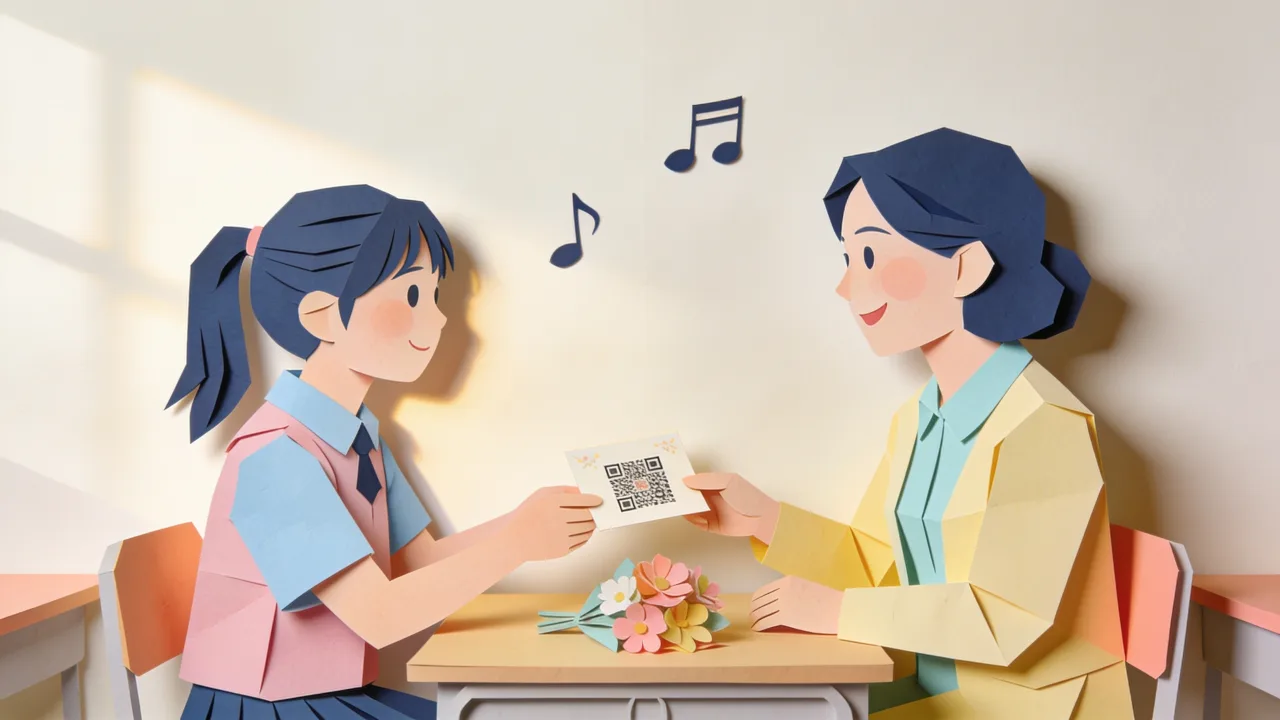
The way a thank-you song arrives shapes how it is received, so plan the handoff as carefully as the chorus. For someone private, deliver it privately: send the link with a short note saying you made something and there is no need to reply, which removes the pressure to react on cue. For a teacher, a coach or a nurse at work, pair the song with something physical they can keep at their desk or in a locker — a printed lyric sheet with a QR code that plays the song works well, because the recording follows them home without any fiddling with files. Our Forever Memory bundle is built for exactly this: a frameable keepsake card with the lyrics and a scannable code, plus a second version of the song in a different style.
For a party or a gathering, choose the moment deliberately. At a retirement lunch, play it after the formal speeches but before people start drifting toward the exit, and make sure the speaker in the room is better than a phone on a table. At a wedding, cue it before the toasts so parents are not already worn out from crying. For a whole team or office saying goodbye to a longtime colleague, a song can sit alongside a group card and a small gift, and holiday ideas for thanking coworkers offers some pairings that do not compete with it. Whatever the setting, do not explain the song before it plays. Say who it is for, press play, and watch their face instead of the screen.
When a class, choir or team performs the song live, rehearse it more than feels necessary and keep the audience small at first. Record the performance even if it wobbles — the recipient will want to replay it long after the event, and a shaky recording of thirty students singing their teacher's name is often treasured more than a polished one. Send the video to the recipient afterward along with the lyrics so they can read what they half-missed through the emotion of the moment. And think about the long tail: thank-you songs tend to get forwarded to spouses, grown children and old colleagues, sometimes years later. A link that is easy to share and easy to find again does more for that second life than any perfect mix.
Where thank-you songs go wrong
Almost every thank-you song that falls flat does so for one of a handful of reasons, and each can be fixed before you record a note. Most come from the same root: writing about gratitude in general instead of about the one afternoon when someone showed up for you.
- A list of virtues instead of a moment — kind, patient and generous describe thousands of people; the chair pulled close at 3 a.m. describes one.
- Every flavor at once — relief, debt and admiration in a single chorus blur together, and none of them lands.
- Leaving out the after — nurses, teachers and coaches rarely learn how things turned out, and that is the part they most need to hear.
- Too long for the room — a five-minute ballad loses a retirement party by the second verse; aim for under three minutes.
- Making it about you — a bridge that dwells on how bad things were can swing the spotlight away from the person you meant to thank.
A song written to thank the person who showed up
Written from your story, with their name in the chorus.