How to Write a Mother's Day Song (Step by Step)

Maya Bennett · Senior Lyricist — Family & Milestone Songs
Updated August 23, 2026 · 26 min read
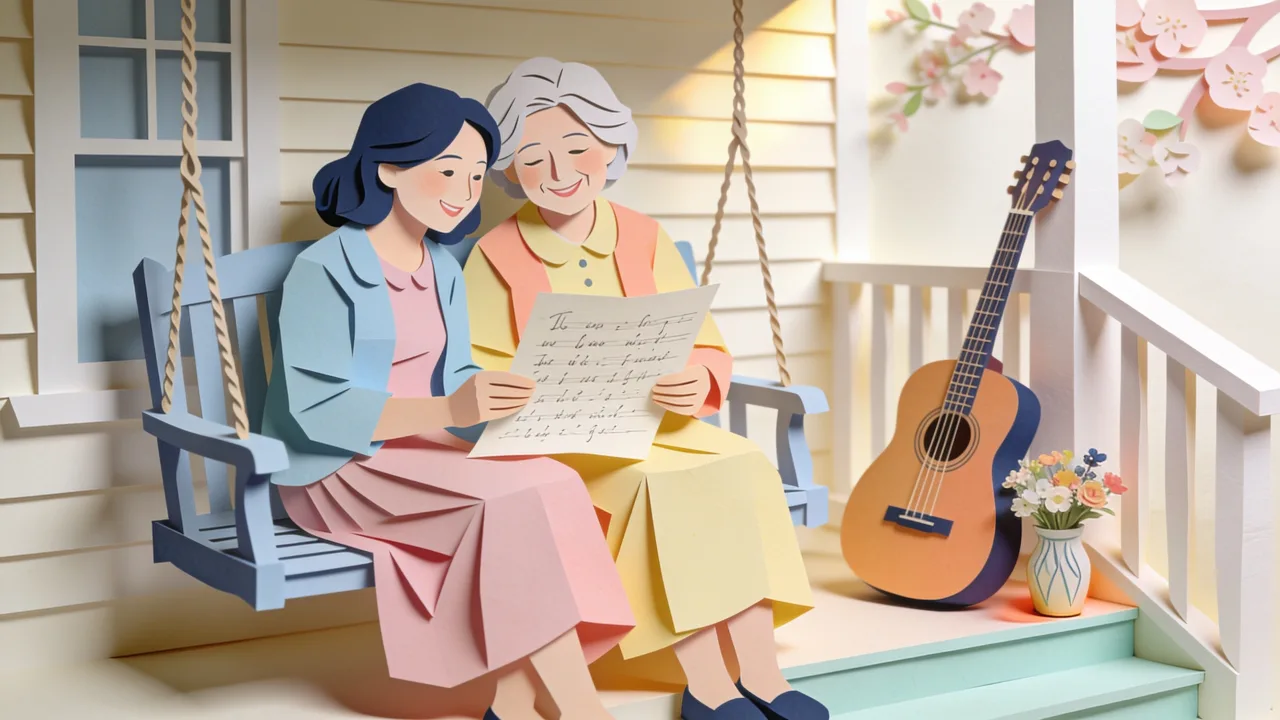
To write a Mother's Day song, take six moves in order: gather the small true things she actually did; settle on the one sentence you want said out loud this year; borrow an ordinary verse-and-chorus frame; build the chorus ahead of any other line; stock the verses with scenes only your family can picture; then set a tune under the whole thing and record it before Sunday. That sequence is the entire method. None of it requires you to read music — it requires a blank page, one honest hour, and enough nerve to put down a thing you have never quite said to her face. Most people who finish one of these are not musicians. They are sons and daughters who sat down and made a list.
The effort is worth spending here precisely because Mother's Day arrives with a default, and the default is weak. A card, brunch at eleven, flowers that will be dead by Thursday, and a sentence everyone at the table says in roughly the same order. The holiday has been running that script for a century and has never once mentioned the specific woman holding the card. A song does the opposite. It uses her name, it remembers something particular, and it proves somebody in the family was paying attention the entire time. It also has to survive conditions no other occasion imposes: a table with siblings at it, possibly her own mother sitting across from her, small children underfoot, and a date on the calendar that will not negotiate with you.
So this guide is built around that reality rather than around general advice about writing for mothers. What follows is the process songwriters actually use, aimed at a dated holiday with an audience and a deadline, plus sections on what changes for a first Mother's Day, a stepmother, a grandmother being honored as the mother she really was, and the Sunday where she is no longer here to hear it. For the wider craft sitting underneath all of this — rhyme, meter, where a melody comes from when you have never invented one — the plain-English version of putting one together from scratch goes considerably deeper than this page will. And if you would sooner pass the story to somebody else and have real singers deliver it in time for Sunday, that option is waiting at the end too.
1Start with the ordinary Sundays, not the holiday
Before a single line of lyric, list what she actually did — not that she was loving and strong, but the particulars. The 6:40 alarm she never complained about. The way she cuts fruit and leaves it on the counter without saying anything. The sentence she has repeated since you were nine. The winter she wore the same coat for three years so you could have a new one. The song she sings wrong on purpose. The tone she uses on the phone when something is genuinely wrong. Aim for twenty entries and do no editing while they land; the unflattering ones, and the ones time has since turned funny, are frequently the strongest, because affection willing to admit a flaw reads as true. Nothing is being chosen yet. You are simply moving your mother from memory onto paper, where you can see which entries still give off heat on a second reading.
Something worth knowing before you start cutting that list. Across years of Mother's Day briefs from families with nothing in common — different countries, different decades, wildly different mothers — the same handful of sensory details keeps arriving: a screen door, keys dropped into a bowl by the front door, one particular pot that only ever held one thing, the smell of her on a coat you borrowed, a hallway light left burning. I used to treat that overlap as a problem and write around it so a song would feel original. I do the opposite now. That repetition is telling you what mothering is actually filed under in human memory — sounds and smells attached to arriving, being fed, and being waited up for. So do not avoid the hallway light. Name which hallway, which house, which year, and the most common image on earth becomes something only your family owns.
If the list runs thin, go and get more rather than straining for it. Scroll the camera roll back five years and stop on the pictures where nobody is posing. Read her texts from the week you were sick. Call a sibling, an aunt, her oldest friend, and let them talk for ten uninterrupted minutes — memory is contagious, and the version an aunt remembers is often better than yours because she watched your mother from outside the house. It helps to hear what the feeling already sounds like, too: skim the songs people reach for when they mean this and notice which ones tighten your throat rather than which ones you admire. Then read the page straight through and mark the three or four entries that either make you laugh aloud or make you glance away for a beat. Those few are your song, and everything else earned its place by helping you find them.
Tip: Write down the thing she believes nobody ever noticed — the shift she picked up, the appointment she quietly rescheduled, the year she went without. Being seen for the invisible half is what makes a mother put her fork down.
2Decide the one thing this Mother's Day is for
A song cannot hold everything she has ever been, so choose one sentence and let it govern every later decision. It might be recognition: I know what it cost you and I know you never said. It might be a late apology: I was awful at seventeen and you stayed anyway. It might be arrival: I have my own kid now and I have finally done the math. Or the plainest one, which is somehow the hardest to say to her face — out of everybody, I would still pick you. Say your candidate out loud once. If a stranger could say the identical thing to any mother at any brunch table in America, it is not yours yet; return to the list, find the one detail that fits nobody else alive, and rebuild the sentence around it. Write three versions and keep whichever you would be slightly embarrassed to read to her.
This is the step people skip, and a skipped one shows within four lines of a first draft: it opens at the hospital where you were born, walks decade by decade through every good thing she ever did, and arrives at the words happy Mother's Day, which gives you a rhyming card set to a tune rather than a song. The repair is not better writing. It is subtraction. Once your sentence exists, hold each memory against it and ask whether that memory serves this claim. The family vacation may not survive the cut. The Tuesday she sat in a parking lot with the engine off, waiting for you to be ready to talk, may carry the whole thing by itself. One clear claim with four supporting details beats a full biography, because nobody feels two things at once and whichever feeling repeats is the one that stays with her.
Let your position in the family choose the angle. A young kid writing for their mom lands naturally on delight — the things they love, said with none of the hedging adults add, which is exactly why children's versions do so much damage. An adult child usually lands on recognition, or on now-I-understand. A husband writing on behalf of small children is really painting a portrait of her as a mother, seen from a chair she does not know she is being watched from. Siblings writing together land on a shared verdict: here is what we all agree you gave us. And if what you feel is gratitude with no complication attached to it, the shape you want sits closer to the way a straight thank-you song is built than to a tribute — shorter, warmer, aimed at one specific kindness rather than a lifetime of them.
Tip: Finish this out loud, in one breath, with nobody else in the room: “Mom, the thing I have never actually said to you is…” The first sentence out of your mouth, before you start improving it, is usually your chorus.
3Give it a shape the Sunday table can follow
Borrow the structure wholesale; nothing is gained by designing your own. A pair of verses, the chorus returning after each, a brief bridge, and then one final pass of the chorus — that frame already holds up nearly every song she loves, and leaning on it costs you no originality whatsoever. The verses carry your specifics, the chorus carries your one sentence, and the repetition is what makes it stick in a house where a television is on and somebody keeps checking the oven. Keep the scale modest: six to eight lines a verse, four lines of chorus, two lines of bridge. That lands around two and a half minutes, which is roughly how long a Mother's Day room will hold still with plates in front of it. A familiar shape is a courtesy. She should be following her own life come back to her in order, not decoding an arrangement.
Plan the bridge now rather than discovering it later, because the bridge is where one of these stops being nice and starts being true. It is the two lines where the grown child says what the child could not: I did not know, and now I do. Or, I have been hard on you and I am sorry. Or, I am frightened of the part where you get older. Two lines is plenty, and the usual error is jamming a third idea in beside them. The mechanism is the same turn described in how a birthday song earns its final chorus; what changes here is direction. A birthday bridge tends to face forward into the year ahead. A Mother's Day bridge almost always faces backward and then admits something. Put the hardest true thing there, then let the chorus return and set everyone down gently.
Then match the shape to where it will actually be heard, because this song gets played in more different rooms than any other occasion produces. At a brunch table with grandparents and toddlers present, put the chorus early and keep it short, so the people who love her can catch it and join the final one. Alone in a car with her, you can afford a slow opening and a longer bridge, because nobody needs entertaining and she can fall apart without spectators. If she lives three states away and this is going out as a file on Sunday morning, build a clear rise — sparse first verse, fuller second, biggest last chorus — because the recording has to do all the work a room would otherwise do. Decide the venue before you draft. A table song and an eight-a.m. file are not the same song.
Tip: Map the blocks on paper before you draft — verse, chorus, verse, chorus, bridge, chorus — and put one word next to each one naming its job. Any two blocks doing the same job means one of them goes.
4Write the chorus first, in words you would say to her face
Draft the chorus ahead of everything else, because it is the part she will remember and the part your verses exist to hold up. Keep it in language you would genuinely use standing in her kitchen. “You went without so I would never know we were short” beats a stack of images about angels and unconditional love. Writing for this holiday fails in one predictable direction: it reaches for wings, roses, hearts of gold, guiding lights and rainbows, and every abstraction you add quietly removes something specific. Put a real noun in there instead — the street, the car, the diner, the ward where she worked nights. And put in the name you actually call her, whether that is Mom, Mama, Ma, or her first name because that is simply how your family operates. The instant that word lands, the song stops being about mothers and becomes about her.
Test every line by speaking it rather than reading it. Anything that sounds like you in conversation with her stays. Anything that sounds like it was already printed inside a card she has been handed twice goes back to the list. Then produce four or five choruses quickly and roughly rather than one with great care; the keeper usually shows up on attempt three or four, after the predictable phrasings have cleared out of your system. You will know it because your own voice changes slightly when you reach it, and that catch in your throat is information, not weakness. Last, check the breathing. Every line has to fit within one unhurried exhale, since whoever delivers it will have shaking hands and a room full of relatives looking at them. If syllables are being crammed in to make a line fit, remove words until it lies flat.
One last test before you move on, and it is the one separating a song from a card. Picture her playing this in October, on an ordinary Wednesday, with no holiday attached and nobody watching her do it. Does the chorus still hold, or does it expire the moment the brunch dishes go in the dishwasher? A chorus built on the date — happy Mother's Day, this special day, once a year — has a shelf life of about four hours. A chorus built on what you know about her keeps working for the rest of her life, and that matters, because mothers replay things. She will play it for her sister. She will play it in the car. She will play it on a day that is going badly and needs evidence the work was worth it. Write the version that survives two hundred listens.
Tip: Try opening the chorus with the name you call her and closing it with the plain sentence — “Ma, you never once let me see it” — so the whole thing is framed between who she is to you and what you finally worked out.
5Fill the verses with the scenes only your family can see
Now put the strongest entries to work, one job per verse. The dependable arrangement is then and now. The first verse reaches back to a version of her only you can still picture: younger, tired, in a kitchen with bad lighting, doing something ordinary you did not understand at the time. The second comes forward to the woman at Sunday's table — slower, grayer, funnier, still doing the same thing with the fruit. Whatever the song makes anyone feel comes out of the distance between those two pictures, since everybody present is privately doing the same sums about the speed of it all. Anchor each verse in one scene that has a location and an hour of the day inside it, instead of a pile of adjectives about her work ethic. Put the listener somewhere they can see, and the feeling arrives unannounced.
Resist the résumé of virtues. Selfless, strong, patient, always there — those four words get handed to every mother alive, they are true of almost everyone's, and stacked together they say nothing at all. What lands is material a stranger could not possibly know: the nickname she gave the car, the specific hand cream, the way she answers the phone, the meal she makes when somebody in the family is sad, the tune she has hummed since before you existed. Those details carry a certainty praise cannot fake, because they prove you were paying attention the whole time, which is the real gift sitting underneath the song. One vivid scene per verse is plenty. Two competing scenes in a single verse will blur each other until neither registers. You are lighting one moment, not narrating her entire life.
Let rhyme be the second concern. Get the honest sentence down and tune its sound afterward; a near-rhyme carrying the truth will always outrank an exact one that merely flatters. Hold one line back for the thing she surrendered without ever logging it as a sacrifice — the degree she did not finish, the town she never left, the career rearranged around a school schedule. And if she is still somebody's daughter, consider one line about her own mother, because a woman being celebrated on this particular Sunday is often quietly thinking about the one she learned it all from, and naming that out loud is frequently the moment her composure goes. Two verses is the entire budget. Everything else you love about her belongs in the card you are writing anyway, and the card will be better for having somewhere to put it.
Tip: If a detail makes your siblings shout in recognition, it is the right detail. Aim for one of those per verse; that jolt of being known is why a song outruns everything else on the table.
6Find the melody and have it finished before Sunday
The tune is closer to hand than most people expect. Speak your chorus with genuine feeling and track where the voice climbs and where it settles; that shape is a melody already, and humming it into your phone traps it before it disappears, which it does within roughly sixty seconds. Anyone who plays can put three or four plain chords beneath the words: keep the verses close to speech and let the chorus widen so the room knows when to lean in. Anyone who plays nothing at all can carry it unaccompanied, or sing across a simple loop. People who cannot play anything write good Mother's Day songs constantly, because the job is remembering accurately rather than arranging. For the mechanics of turning a hummed idea into a file you can send, building a recording out of gear you already own covers the phone settings and room tricks that stop it sounding thin.
Then finish it on purpose, ahead of the date. Mother's Day does not move, which is the one genuine advantage of writing for a holiday instead of a whim: set your private deadline for the Thursday before and record whatever exists by then. A rough voice memo is a finished song. The wobble is not a defect in the gift — for most families it is precisely why that file never gets deleted. If you intend to sing it live, run it out loud three times beforehand, including once standing up, so nerves do not swallow your second verse, and print the lyrics to keep folded in a pocket. No one at a Mother's Day table has ever objected to somebody reading from a sheet, and no one forgets the relative who stood up in a dining room and sang to their mother regardless.
And if you would rather your words arrived with a real melody and professional vocals behind them — no performing, no karaoke courage required — that is the work we do. A questionnaire taking about five minutes is enough to hand over the details, the one sentence and the name you call her, and real songwriters turn it into an original song written for her and properly sung in whatever style suits the woman: acoustic for the quiet one, country for the kitchen radio, gospel or soul for a mother who raised you in a church pew, a lullaby for a brand-new one. Finished songs land inside 24 hours, and express can turn one around in about an hour when Sunday happens to be tomorrow. Yours arrives on a private page that you can play at the table, download, or drop into the family group chat, backed by revisions without limit and a money-back guarantee running a full 30 days.
Tip: Record a clean take a few days early even if you also plan to sing it live. If your voice gives out at the table — and it might — you can press play instead and spend those three minutes watching her face.
A worked example: one list, one sentence, four lines
Here is the whole method in practice, using an invented family so you can watch the moving parts. Nina is writing for her mother, Rosa, and her step-one list is not tidy. Rosa took the four a.m. shift at a bakery for eleven years and came home smelling of yeast. She kept one chipped blue mug and would not let anybody throw it out. She sang along to the radio with the wrong words on purpose, to make her kids laugh. She said “eat something first” before every difficult conversation that ever happened in that house. And the porch light was on every single night Nina came home late, from the year she got her license to the year she moved out, and neither of them ever mentioned it once.
Reading it back, the item Nina cannot get past is the porch light — because it is the only thing on the page Rosa never claimed any credit for. So the sentence arrives: I thought that light came on by itself, and it took me twenty years to understand somebody was walking down a dark hallway to turn it on. That is not “you are the best mom in the world,” which Rosa has already read on a hundred cards from three children. It is narrow, it belongs to one house, and it is something Nina has genuinely never said out loud, which is exactly how she knows she has the right one. Every other item on the list now has a job: support that sentence, or go in the card instead.
From there the chorus writes itself in words Nina would really use. These four lines are made up for this guide — an example written from scratch to show the shape, not borrowed from any existing song: “The porch light was on every night I came home late / and there was always a plate, and you never said you were tired / I used to think that light just burned there on its own — / Ma, somebody had to walk down the hall and turn it on.” It is not clever, and that is deliberate. Line one is a fact lifted straight off the list. Line two adds the second unclaimed kindness plus the thing Rosa never said, which is where the ache starts. Line three states the child's version of events, innocently. Line four is the turn: the grown daughter correcting the child, with the name she actually uses sitting right in front of it.
The verses then have obvious addresses. Verse one lives at four a.m. in the bakery and in the smell of yeast on a coat, with a kid asleep in a house somebody had already been awake in for hours. Verse two moves to now: Nina at a table on Sunday with her own daughter, cutting fruit without having decided to, Rosa across from her holding the blue mug. The bridge is two lines built on “eat something first” — the phrase handed back by a daughter who catches herself using it and finally understands what it was for. One list, one sentence, and a chorus drawn from both, and three quarters of the song exists before anyone has touched an instrument.
When the mother in the song is not the standard one
A first Mother's Day is a different song entirely, because there is almost no shared history to draw on — the material is nine months old and consists largely of exhaustion. Write it forward instead of backward. The details are the ones from the past few weeks: the three a.m. chair, the way she holds the baby's head, the tune she has already invented and sings without noticing she is doing it. The message is usually some version of I watched you become somebody new and I want you to know I saw it happen, which is what a brand-new mother most needs and almost never gets, because every other person in the room is looking at the baby. If it comes from her partner, keep it about her rather than about the child. The same instinct sits behind songs marking a new arrival, only aimed one person to the left.
A mother of grown children wants something different again, and it is the version most gift-givers get wrong. She does not need reassurance that she did a good job with small kids; she needs evidence that the adult you turned into still notices her. So write from now, not from 1998. The strongest verse available is the one where you admit what you understand today and could not possibly have understood then — the money, the loneliness, the decisions she made without telling anybody. If she is old enough that time has started to feel like an object in the room, one honest line about that outweighs a whole verse of childhood nostalgia. These songs also carry a specific risk: sounding like a eulogy delivered early. Keep at least one line funny. She is still here, and she is still entirely herself.
For a stepmother, an aunt, a grandmother who did the raising, or a friend's mom who quietly adopted you, the single most powerful move is to name how she arrived. You did not have to is the whole engine of that song, and it is a sentence a biological mother never gets to hear. Say when she came in, say what she walked into, and name one specific thing she did before she had any obligation to do it — the drive, the paperwork, the school concert she showed up to on her own initiative. Avoid comparison completely; a song that scores her against anyone else, favorably or not, will land badly on Sunday. If you are honoring a grandmother as the mother she effectively was, songs written about grandmothers show the register that works, and a song made for the grandmother who raised you is a common request for exactly this reason.
And then there is the Mother's Day where she is not there, which most pages on this topic skip entirely. If that is your situation, here are a few practical notes and no promises. Write it small. The instinct is to attempt a summary of her whole life, and a summary will defeat you; one afternoon, one room, one thing she used to say is more bearable to write and far more bearable to hear. Present tense often helps — describing her doing something, rather than announcing that she is gone. Decide in advance who will hear it, because a song made for yourself and a song played for the whole family on Sunday are different objects, and you are allowed to make only the first. The craft side is handled properly in writing about someone who has died. It will not fix the day. It may give you something to do with your hands on it.
- First Mother's Day: write from the last few weeks rather than a shared history — the three a.m. chair, the invented lullaby, the person she is turning into.
- A mother of grown children: skip the childhood highlight reel, write from now, and admit what you understand today that you could not have then.
- A stepmom or the woman who raised you: build it on “you did not have to” — when she arrived, what she walked into, the first thing she did with no obligation to do it.
- A grandmother honored as a mom: use the details only her grandchildren know, and let more than one generation put a line in.
- A Mother's Day without her: keep it to one room and one afternoon, decide beforehand who is allowed to hear it, and let it stay small.
Giving it to her on the day
When you play it matters nearly as much as what is inside it. The reliable slot is after the plates are cleared and before anybody starts organizing the kitchen — early enough that nobody has drifted off, late enough that the eating is done and a room can be quiet for three minutes. Do not open the day with it; a song at nine in the morning leaves eight hours of everyone pretending not to be emotional. If your mother enjoys being celebrated in front of people, put her in the center chair, start the speaker, and let the table watch her. If she is the sort who deflects attention with a joke, do the exact opposite: the car, the porch, the kitchen at the end of the night, one person and one phone, so she can come apart without spectators and reassemble herself privately.
Handle the siblings before Sunday rather than during it. If more than one of you is in on it, agree who presses play and who says the one sentence beforehand, because a scramble at the table takes the air straight out of the moment. If you made it alone and they did not, tell them in advance instead of ambushing them — the quickest way to spoil the whole thing is leaving a brother sitting there feeling like the gift he brought just got beaten in public. Offer to put their names in it, or simply let them know it exists before it plays. And if she lives far away and this is arriving as a file rather than a performance, the register you want sits closer to songs about missing someone than to anything celebratory, because distance is already the loudest thing in the room.
Give her something to hold, too, since a song is the rare gift with no object attached. The lyrics printed on decent paper, folded into a letter, or a keepsake card with the words on it and a code she can scan to hear it again from her own kitchen whenever she feels like it — mothers replay things, so make replaying easy and put it somewhere she walks past. Then decide between singing live and pressing play. Live is braver and, when it works, the thing your family will still be describing in ten years; a dining room is also the most forgiving audience on earth. Practice standing up, pick a key you can still reach when your throat tightens, and hold the paper without apologizing for it. A recording is safer and often the better gift, because it survives the day and she can play it in November.
As for crying: you probably will, and it is worth deciding now that this is fine. If your voice goes halfway through the second verse, stop, breathe, and start the line again — nobody at that table wants a composed performance, and the moment your voice breaks is usually the moment she understands you meant it. If you would rather not gamble, record a clean take earlier in the week and play that instead, then let yourself simply sit and watch her hear it. Either way, resist the urge to talk over the ending with an explanation of what you were going for. Let it finish. Let the silence sit for a second. She will say something, or she will not be able to, and both of those are the song working exactly as intended.
What makes a Mother's Day song fall flat
These fail in a narrow and predictable set of ways, and nearly all of them come from writing about mothers in general instead of about this one:
- Writing the holiday instead of the woman — “happy Mother's Day, you're the best” is the card she already owns; the porch light is the thing only you can hand her.
- Reaching for wings and hearts of gold — every abstraction you add takes a detail out, and the details are the entire reason it works.
- Trying to cover her whole life — one afternoon remembered exactly will outrun a decade summarized, every time.
- Airbrushing the hard years — a song pretending there was never any strain flatters her without moving her, because she was there for all of it.
- Missing Sunday — the date does not move, and a shaky voice memo played at the table beats the perfect song still in your head on Monday.
A custom Mother's Day song written for her
Written from your story, with their name in the chorus.