How to Write a Valentine's Day Song (Step by Step, Before Feb 14)

Jordan Ellis · Music Producer & Vocal Director
Updated October 7, 2026 · 22 min read
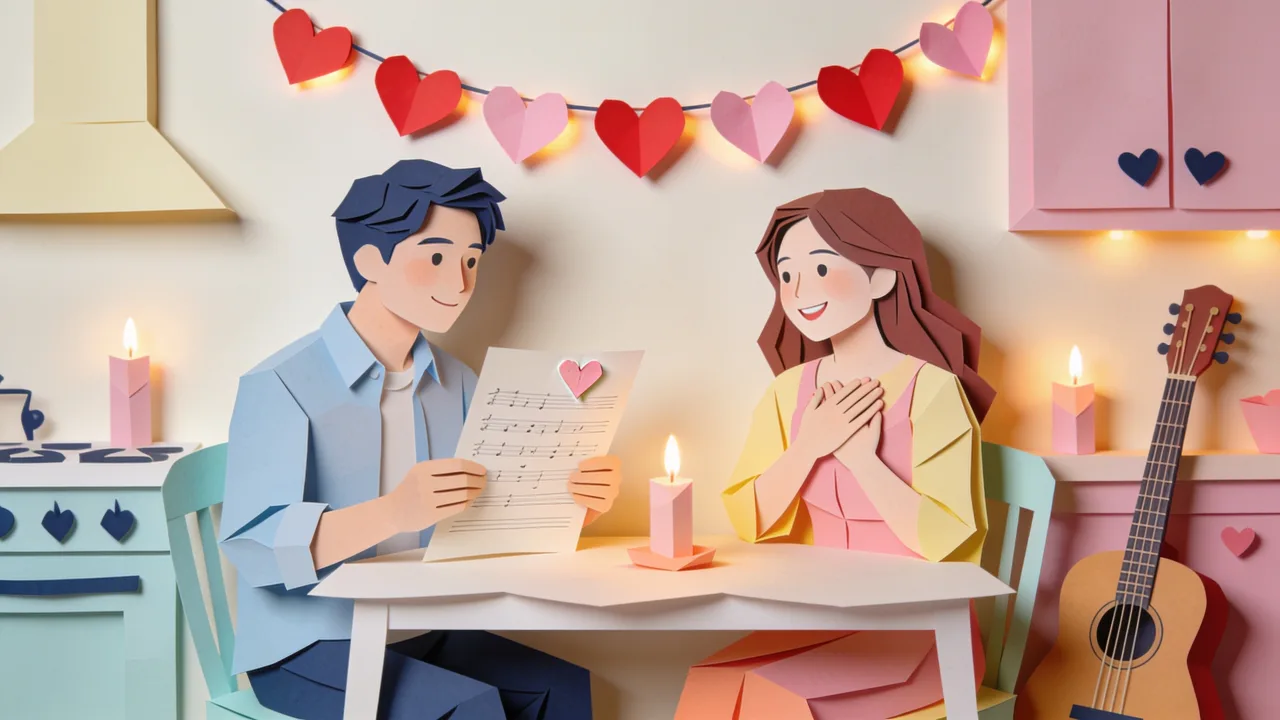
To write a Valentine's Day song, choose one small true story from your relationship, decide the single feeling it proves, set that feeling as a four-line chorus in plain speech, and hang two short verses around it: one scene from early on, one from this winter. Then hum it into your phone and finish it at least three days before February 14.
The holiday itself is the thing working against you. Every store aisle in February is selling the same vocabulary — roses, hearts, forever, my one and only — and the moment you sit down to write, that vocabulary floods the page because it is the only romantic language you have been handed all month. A Valentine's song lands when it does the opposite of the aisle: it names the exact bus stop, the burnt toast, the voice note at two in the morning, and lets the card-shop words stay in the card shop. Your partner already owns a drawer of cards. Nobody owns a song about the night their umbrella broke.
The six steps below are the order I would walk anyone through, whether you have been dating since October or married since the last century, and they assume no instrument and no training. Where the craft overlaps with any song written to a partner, the general love-song method goes deeper on rhyme and chords; this page stays on what February changes — the stage your relationship is at, the inside joke versus the grand gesture, a deadline that does not move, and how to actually hand the thing over on the day. If you decide halfway through you would rather have it written and sung for you, that route is at the end.
1Find the one story that only the two of you know
Set a timer for twenty minutes and list moments, not adjectives. Not she is beautiful, but the night she fell asleep mid-sentence on the phone and you stayed on the line listening to her breathe. Not he is so thoughtful, but the way he warms your side of the car before you come outside. Write every one down, including the small, silly and slightly embarrassing ones, because Valentine's songs live or die on intimacy and the embarrassing memories are usually the most intimate. Think about where you were the first time you noticed you were happy, what you argued about on your first trip, the text you have screenshotted and kept. You are not writing yet. You are building a pile of raw material large enough that the song can afford to throw most of it away, and twenty scrappy lines will always beat five polished ones at this stage.
Now read the list back and sort it into two columns: inside jokes and grand moments. Inside jokes are the nickname, the mispronounced menu item you both still use, the fake rivalry over who loads the dishwasher properly. Grand moments are the first kiss, the move across the country, the hospital waiting room. February pulls people toward the grand column because the holiday feels like it demands scale, but the inside-joke column is usually where the song's heart is hiding. A grand moment tells the listener your relationship was important. An inside joke tells your partner that you were paying attention, and that is the message almost everyone wants to hear on the fourteenth. The strongest Valentine's songs tend to use one grand moment as the frame and fill it with two or three inside jokes.
If the list stays thin, go looking rather than remembering. Scroll your photos back to the first month you were together and write down what is physically in each picture — the jacket, the diner booth, the dog that was not yours yet. Search your messages for the first time either of you wrote I love you, and note what the conversation was about right before it. Listening is useful too: a round of the songs people send the women they love will show you how often the line that hits hardest is a plain fact about a Tuesday rather than a declaration. Circle the three entries on your list that would make your partner say how did you remember that. Those three are your song, and the rest is scaffolding.
Tip: Ban these five words for the first draft: forever, perfect, angel, soulmate, heart. They belong to every Valentine ever written, which is exactly why they do not belong to yours.
2Choose one feeling that fits where you are right now
Before any line of lyric, write one sentence at the top of the page: the single thing you want your partner to understand when the song ends. Where you are in the relationship decides what that sentence can honestly be. Three months in, it might be I did not expect you and I am glad I was wrong. Two years in, it might be you are the person I want to tell things to first. Twenty years in, it might be we are still the two people at that table. The mistake February invites is borrowing a sentence from a later chapter — promising forever on a fourth date, or writing a giddy first-crush song to a spouse of fifteen years. Your partner hears the mismatch instantly, and it makes even the true lines sound performed. Write for the chapter you are actually in.
Then decide on the temperature: funny, sincere, or the mix that works best, which is funny verses and a sincere chorus. This is a production decision as much as a writing one, and it is the call I make most often on Valentine's recordings. When I am producing a song for a couple in their first year, I usually nudge the tempo up and keep the vocal close and a little breathy, because new love sounds like someone talking slightly too fast; for a long marriage I slow it down and drop the singer into a lower, warmer register so the song sounds unhurried and sure of itself. Picture which of those two voices fits your sentence. That picture will steer every word choice you make in the next four steps.
Test the sentence out loud with your partner's name in front of it, the way you would say it across a kitchen counter. If you can say it without flinching and it still feels like it costs you something, keep it. If it slides out too easily, it is probably a card sentiment wearing your clothes; go back and make it more specific. If saying it makes your voice change, that is the one. And if you find yourself torn between two good sentences, keep the one that belongs to this February in particular — the year you moved in, the winter you were apart, the first Valentine's after the baby — and fold the runner-up into the bridge. A song built for one specific February ages better than a song built for every February.
Tip: Fill in this blank out loud: "This year, what I actually want you to know is…" The first answer, before you tidy it, is usually the chorus.
3Build a short shape that survives the big day
Use the structure underneath nearly every song your partner has ever hummed: verse, chorus, verse, chorus, a two-line bridge, then the chorus once more. Do not try to be clever with form; Valentine's Day is already a crowded evening, and a familiar shape lets your partner stop decoding and start listening. Give each section a job before you draft a word. Verse one is the past: the scene from early on. Verse two is the present: an ordinary moment from this winter that proves the first scene was not a fluke. The chorus is the one sentence from step two, unchanged on every return. The bridge is the one thing you would not quite say over dinner. Sketching that on one page takes five minutes and saves you from the classic failure, a relationship timeline set to music.
Keep it shorter than your enthusiasm wants. Two verses of four to six lines, a four-line chorus, two lines of bridge — sung at a relaxed pace that comes in around two and a half minutes. There is a practical February reason for this beyond taste. The song is going to be played somewhere specific: across a restaurant table off a phone, in the car outside the house, on a video call to another time zone, or in a quiet living room with candles going. Every one of those settings is friendlier to a short song. A long one starts to feel like a performance your partner has to sit through politely, and the moment they start managing their face for you, the song has stopped being a gift and become an event.
If you are deciding between a slow ballad and something brighter, let the shape help. A ballad wants fewer words per line and longer held notes at the end of each chorus line, so trim your lyric hard and leave space. An upbeat, playful song can carry more syllables and quicker internal jokes, especially in the verses, but the chorus should still slow its thinking down even when the tempo does not. In arrangement terms, the most useful trick for a Valentine's song is a drop: strip everything back to one instrument or no instrument at all for the bridge, then let the full sound return on the last chorus. Even a phone recording can do this — just stop strumming for the bridge. That small silence is where your partner will look up.
Tip: Draw three boxes: then, now, and the thing you have never said out loud. If a line fits none of the three, it is a phrase you like, not a lyric yet.
4Write the chorus first, in words you would say on the couch
Start with the chorus. It is what your partner will still be humming on February 15, so it deserves your freshest hour. Draft it in the register you actually use with them on a Sunday morning, not the register of the card aisle. You still steal the blanket and I still let you is a chorus. My love for you burns like a thousand suns is a balloon. The melody is going to lift every word on its own, so the words do not need to lift themselves; if they try, you end up with something that sounds like a jewelry commercial. The plainest version of your sentence from step two is almost always the one to build around. Put your partner's name, or the name only you call them, at the very start or the very end so the song is unmistakably addressed.
Now write five versions of that chorus quickly and read each one aloud at normal speaking volume. Cross out any version that would work for your best friend's partner just as well, which usually eliminates two or three. Cross out any version you would be embarrassed to say while looking at them, because that embarrassment will be audible the moment you sing it. What survives tends to be the plain one rather than the clever one. Then let line four circle back to line one so the chorus closes like a door instead of trailing off. Check your breath: if you cannot sing a line comfortably in one breath, cut words rather than meaning. Fewer syllables also give a singer room to hold the last note, which is where a lot of the feeling lives.
The Valentine's-specific trap here is the rhyme bank everyone reaches for in February: heart and apart, love and above, you and true, fire and desire. Those pairs are not wrong, but your partner has heard them in every song on the playlist of songs written for boyfriends and girlfriends and will hear the rhyme coming a line early. Near rhymes are your friend: coat and close, rain and again, kitchen and listening. They sound natural and they let you keep the true detail instead of bending it to fit the sound. If a line only works because of the rhyme, rewrite the line. If a detail only works by changing what really happened, keep the detail and drop the rhyme. Truth wins over chime every time someone is listening closely, and on Valentine's Day they will be.
Tip: Copy the chorus out four times down the page and read it top to bottom. If you are bored by the third pass, you have written decoration, not a chorus.
5Fill the verses with one February-sized scene each
Each verse gets exactly one scene, told slowly enough to see. Verse one reaches back: the bus shelter on your first night out, the bowling alley where neither of you could bowl, the voice that came through the phone the first time they called instead of texting. Verse two comes forward to this winter: the way they leave the porch light on now, their coat on your hook, the argument last week that ended with both of you laughing at the same moment. Put those two scenes next to each other and your partner does the math without help: then became now, and it held. That contrast is the engine of a Valentine's song, and it is why you do not need to explain anything. Resist the urge to tour the whole relationship in eight lines; summaries sound like toasts.
Write what a camera could have caught. Not we were so happy, but the paper crown from the takeout place you both refused to take off. Not you take care of me, but the mug they hand you already stirred. Give each verse an object to hang from — the ticket stub, the scarf, the chipped bowl you eat cereal out of at midnight — because objects hold a relationship better than adjectives and they hold up when sung. February adds a useful seasonal palette if you want it: cold hands, fogged windows, the early dark, the salt on the car. Use one wintry detail per verse at most, and only if it is true. Weather invented to set a mood reads as filler; weather you actually remember reads as a memory.
Then read both verses aloud to someone who knows you both, or at least out loud to the empty room. A laugh of recognition, a pause, or a soft oh means a line landed. A polite that's nice means you are still writing in general terms. The country tradition is the best teacher here; the country songs couples keep coming back to are built almost entirely out of trucks, porches, kitchens and specific Saturdays, and they almost never say the word love in a verse. Borrow that discipline. Keep the inside joke intact even if no one else will get it — especially if no one else will get it. A Valentine's song is the one gift where being incomprehensible to strangers is a sign you did it right.
Tip: If one verse visits two places, it is a summary, not a scene. Split it or cut the weaker half before you go near a melody.
6Find a tune, record it, and finish before the fourteenth
Your melody is already inside the way your voice moves when you read the chorus and mean it. Read it aloud five or six times, let it drift into a sing-song, and record every attempt on your phone. Listen back for where your pitch lifts and where you pause for air; exaggerate those on purpose and you have a tune. Keep the verses low, close to your talking voice, and let the chorus climb a few notes above them so it feels like the song is opening up. If you play guitar or piano, three or four chords are plenty, and keep them steady so the words stay in front. If you do not play, sing over nothing at all or speak the lyric over a soft chord loop; for a Valentine's song, a slightly unsteady voice reads as nerves, and nerves read as love.
Now the calendar. February 14 does not move, and the mistake that ends more Valentine's songs than bad lyrics is starting on the twelfth. Work backward: have the words finished by the tenth, record on the eleventh, and leave two days for the song to sit before you listen to it again, because one night away is the best editor you will ever hire. Record in a small soft room — a bedroom with the curtains drawn swallows echo — with the phone a hand's width from your mouth, slightly off to one side. Sing it straight through three times without stopping to fix anything and keep the take that feels most like talking to them. Send the file to yourself immediately. Phones die on the thirteenth with alarming reliability.
If you would rather your partner heard it fully arranged and sung by a trained voice, that is the part we do. You answer a questionnaire of about five minutes — the three details you circled, the sentence you want them to keep, the music that actually plays in your car — and real songwriters build an original song from it, recorded with real vocals in acoustic, pop, country, R&B, soul, gospel or folk. You can have it written and sung for your Valentine and still give your own voice memo first; plenty of people do both. Delivery comes within 24 hours, there is an express option as fast as an hour for anyone reading this on the thirteenth, revisions run until it sounds like the two of you, and there is a 30-day 100% money-back guarantee.
Tip: Before you record, say the chorus once to their photo on your phone. It sounds silly, and it pulls your voice into the register you use with them instead of the one you use for strangers.
A worked example: from a broken umbrella to a Valentine's chorus
Here is the method running end to end. Nadia is writing for Theo, her boyfriend of two years, and her first draft went where February drafts always go: you are my everything, my Valentine, my love forever. It is sweet, and it would fit any couple in any city, which is the test it fails. Read it with someone else's name in it and nothing breaks. So she started again with the timer and the adjective ban, writing only things a camera could have caught.
The second list was full of facts. They met at a bus stop in a February downpour when her umbrella turned inside out and Theo, a stranger, held his coat over both of their heads while they waited for a bus that never showed. They walked forty minutes to her apartment instead. He still burns the toast every Sunday and calls it caramelized. When something goes wrong, she says we'll walk it, which started that night and now means we will figure it out.
Her sentence, after one night of sitting with it: I would wait at that bus stop again. Two years in, that is the right size — not forever, but a clear, plain yes to the same choice. The chorus came almost straight from the list, in words Nadia actually uses: "You held your coat over my head / the night the last bus never came. / Two winters in and I still say / I'd wait at that stop in the rain." There is no heart, no star, no fire in it, and it could not be about anybody else.
The verses then had obvious homes. Verse one took the bus stop, the useless umbrella and the forty-minute walk. Verse two jumped to a Sunday this winter: the smoke alarm, the caramelized toast, his coat now hanging on her hook by the door. The bridge was two lines built on we'll walk it, handed back to him as a promise. She recorded it in her car outside work on February 10, kept the second take, and played it for him on the fourteenth at the same bus stop. It was not raining. It did not need to be.
New love, long marriage, long distance: what changes
The six steps hold for every relationship, but the stage you are in changes the sentence, the tone and how much history the verses can lean on. A new relationship — a few weeks to a few months — has little past to draw from, so the song should be about the surprise rather than the history: the moment you realized this was something, the habit of theirs you already know by heart. Keep it light and do not promise anything the relationship has not earned yet; a song that says I am glad I met you is generous, while one that says I will love you forever on the fifth date reads as pressure. If you are writing for someone you have only just started seeing, the guide to writing for a boyfriend handles that lighter register well.
A long-term partner or a spouse is the opposite problem: too much history, and a partner who has heard every version of I love you you own. Here the strongest Valentine's songs are about the ordinary present rather than the dramatic past — the way you still save them the last bite, the shorthand you have developed, the hard year you came through together. Married couples can afford to be quiet and certain; the song does not need to convince anybody of anything. If he has heard it all, our walkthrough for writing to a husband covers how to surprise a man who thinks he knows every line you have, and if the song is doubling as an anniversary marker, songs couples choose for the years together show how others frame the long view.
Long distance changes the job entirely, because on February 14 the song may be standing in for you. Name the exact things the distance has taken this month — the weight of their arm in the cinema, the two toothbrushes that are now one, the time-zone math you do before every text — and then land on something certain, like a date or a plain promise, so the song does not leave them lonelier than it found them. The craft of writing toward absence is covered in the guide to writing toward someone who is not there. And funny versus sincere is a dial rather than a switch: a teasing song works when your relationship already runs on teasing, but even the funniest Valentine's song should give one line to the sincere thing, usually in the bridge, where it lands harder because they were laughing a second ago.
- New relationship: write the surprise, not the history. Keep it light and promise nothing the relationship has not earned yet.
- Long-term partner: write the ordinary present — the habits, the shorthand, the hard year you got through.
- Married: be quiet and certain. The song does not need to persuade, only to notice.
- Long distance: stay concrete about what you miss, then end on something certain, like a date or a promise.
- Funny: tease in the verses, then turn sincere for one line in the bridge.
- Galentine's or a friend: the same steps work for a best friend — swap romance for loyalty and lean into the inside jokes.
How to give it to them on Valentine's Day
The first listen is half the gift, so stage it rather than improvising. The most reliable version is the least theatrical: after dinner, phone on the table, a request for three minutes, and you watching their face instead of the screen. If your partner hates attention, skip the restaurant and play it in the car or at home, where they can react without strangers watching. If they love a moment, go back to the place in verse one — the bus stop, the diner, the bench — and play it there. For long distance, schedule a video call, share your screen so the audio is clean, and say nothing for the first thirty seconds afterward. Whatever you choose, do not play it in the middle of a crowded restaurant with a server hovering.
Give them something to hold, too, because a song arrives with no box. Print the lyrics and tuck them into the card, write the chorus inside the front cover of a book, or frame the words. The Forever Memory bundle exists for exactly this: a keepsake card you can frame, carrying the lyrics beside a QR code that starts the song when scanned, along with a second recording in a different style, which is useful if you pictured acoustic and they quietly love R&B. Whatever the object, playing it again should take one motion. A private link they can text to their sister is better than a file buried on your phone, because they will want to share it, and that is the best review the song can get.
Finally, think about pairing rather than replacing. A song does not have to compete with dinner or flowers; it is the part of the evening that will still exist next February. If your partner is the girlfriend who keeps every ticket stub, a song written around her story sits naturally beside the rest of her keepsakes. And if Valentine's is not the right day at all — the relationship is too new, the day is too loaded, or you simply missed it — the same song works on an ordinary Wednesday, sent as a love song with no occasion attached, which is sometimes the most romantic timing there is. For couples apart on the day, a few of the long-distance gifts that travel well pair with a song nicely.
Where Valentine's Day songs go wrong
Nearly every Valentine's song that misses does it for one of five reasons, and all of them are easy to catch on a second read before February 14:
- Card-aisle vocabulary — roses, hearts, forever and soulmate belong to everyone, so they say nothing about the two of you.
- Promising the wrong chapter — vows of eternity on a new relationship, or giddy first-crush lines to a spouse of fifteen years.
- The whole relationship in one song — a timeline from first date to today is a slideshow caption, not a scene.
- Rhyming on autopilot — heart and apart, fire and desire, true and you; your partner will hear the rhyme coming a line early.
- Starting on February 12 — no time to sleep on it, no time to re-record, and a phone that dies on the thirteenth.
A Valentine's song written for your partner
Written from your story, with their name in the chorus.